DISCOVERY
SEO, LLM, and GEO optimization.
Google's AI features still start with strong SEO: useful pages, crawlable structure, and clear source material. We help your site become the answer buyers can find, trust, and cite across Google Search, AI Overviews, ChatGPT, Claude, and Perplexity.
The three layers
SEO, LLM SEO, and GEO: what each one actually means.
These terms get used interchangeably, but the priority order matters. Google's own generative AI search guidance frames AEO and GEO as extensions of SEO, not replacements. The practical job is to make the site helpful enough for people, crawlable enough for search, and specific enough for AI systems to quote without flattening the business into generic category language.
01· Foundation
Traditional SEO
Get into the index. Earn the click or the snippet.
- Crawlability, indexation, speed, and internal linking still gate everything.
- No rank in Google or Bing means no reliable source material for AI downstream.
- Google's AI features rely on core Search ranking and quality systems.
Live demo
Ask an AI what Buzzed is, right now.
We optimized this site for LLM discovery. Try one of the agents below and see the results of the Buzzed Method.



Proof on this site
How we apply Google-aligned GEO to buzzedtech.com.
We dogfood the work on our own site. The emphasis is not a magic AI file or a schema trick; it is useful pages, clear architecture, visible proof, and optional agent context around that source material.
Measured on this domain
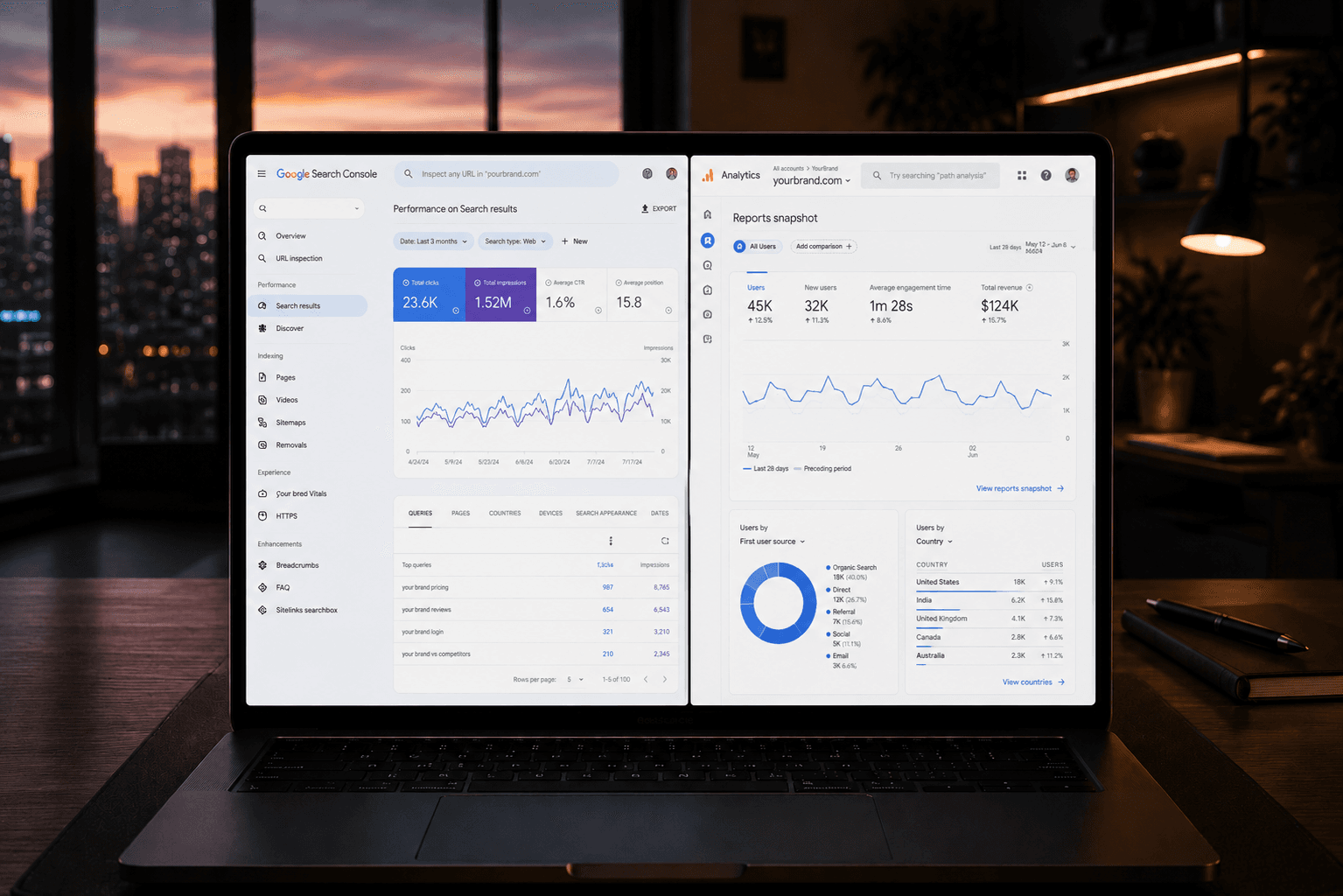
The same method, run on buzzedtech.com. Ninety days in Google Search Console.
- +129%
- Search impressions
- 2.2×
- AI Overview impressions
- 86%
- of recent days cited in AI answers
- 4×
- Daily search volume
Final 30 days versus the first 30. Google Search, this domain.
Last 28 days versus the first 28, in Google’s AI Overviews and AI Mode.
AI Overviews and AI Mode now cite the site on most days. That was not true in May.
How much more often the site appears in Google Search than it did in May.
Source: Google Search Console, Web Search, May 16–August 15, 2026. Equal-length windows compare the start and end of each export. Daily volume compares May 16–31 with August 1–15.
Proof on this site
Buzzed discovery architecture map
Useful pages for real buyer problems
Service, use-case, case-study, and field-note pages are built around specific work we do, the questions buyers ask, and proof a human can evaluate before they ever become structured data.
Crawlable technical foundation
Canonical metadata, sitemap coverage, robots rules, renderable content, internal links, and fast page templates give Google and other crawlers clean source material to retrieve.
Structured data that matches visible content
Organization, Service, BreadcrumbList, Article, and FAQPage schema are used where the page actually supports them, so machines get typed context without hidden or unsupported claims.
Optional agent context
/llms.txt and /llms-full.txt summarize services, case studies, field notes, team details, and key facts for assistants that choose to inspect them. Google does not require these files; they support agents without replacing the real pages.
Search Console and answer monitoring
The external follow-through matters: verify Search Console, submit the sitemap, inspect rich results, and re-test important brand and category queries as the site earns more proof.
Google's guidance is clear: special AI files, chunking, and AI-only rewrites are not required for generative AI search. We still support optional agent-friendly context because some assistants may use it, but the core work is the same thing search has always rewarded: satisfying, reliable, original pages.
Why it matters
The case for doing this now.
Classic SEO still matters, but a growing share of high-intent research happens in tools that don't render your meta description. ChatGPT, Perplexity, Claude, and Google's AI Overviews summarize categories and recommend providers without anyone clicking a blue link.
If your content is generic, thin, blocked, slow, or inconsistent, there is less for search systems and AI assistants to retrieve. GEO builds on SEO: first make the site useful, indexable, and easy to understand, then make the expertise specific enough to quote.
What’s included
How we ship this.
Audit: what search and AI can cite now
We run brand and category queries through Google Search, AI Overviews where available, ChatGPT, Claude, and Perplexity, then map the source material behind each answer.
Foundation: fix discovery and page experience
Crawl errors, indexation gaps, canonical problems, page speed, render-blocked content, weak internal links, sitemap coverage, and Search Console setup. No GEO work survives a site crawlers cannot reach.
Content: publish useful pages for real intents
Turn generic service copy into expert-led pages with specific examples, FAQs visible to humans, proof points, case-study links, and clear sections that match the searches buyers actually make.
Structure: make the source material unambiguous
Add accurate metadata, internal links, Organization and Service JSON-LD, image and video context where useful, and optional text endpoints for agents. Structured data supports the page; it does not replace the page.
Measure: answer accuracy over time
Re-test the same buyer queries monthly. Track whether your brand appears, whether the description is accurate, whether the cited pages are the right ones, and what new content would genuinely help.
How we ship this
Five-step GEO engagement timeline
Audit01 · Audit
Index02 · Index
Content03 · Content
Structure04 · Structure
Measure05 · Measure
Data points
The numbers behind the case.
Sources are linked beneath each number. Items marked typical range come from our own engagements rather than a published study.
Still SEO
Google's official guidance: optimizing for generative AI search is optimizing for the search experience
Required
pages must be indexed and eligible for a Google Search snippet before they can appear in Google's generative AI features
Core
Google's guidance prioritizes unique, helpful, people-first content over commodity pages or AI-search hacks
Foundational
crawlability, JavaScript SEO, page experience, and duplicate-content control remain core to AI search visibility
Helpful
structured data can support rich results, but Google says there is no special schema required for generative AI search
Optional
llms.txt and other special AI files are not required for Google's generative AI search features
Data points
Citation share over time
8 category queries · monthly re-test
- ChatGPT
- Perplexity
- Claude
- Google AI
Where this shows up
What this looks like in practice.
Buzzed Technologies (this site)
We use the same foundation on our own domain: crawlable service and use-case pages, canonical metadata, JSON-LD that matches visible content, a generated sitemap, field notes with first-hand POV, and optional /llms.txt context for assistants that choose to read it. Try the live demo on the service page: ask ChatGPT, Gemini, or Claude what Buzzed is.
Real engagement, dogfooded
Armonk-Somers Podiatry — specialty practice, Westchester NY
Replaced a static brochure site with crawlable service and FAQ pages, structured content assistants can parse, and a safeguarded AI assistant—giving search engines and LLMs specific source material about the practice instead of one generic landing page.
Real engagement
Read the case study →Common questions
What Google's AI search guidance changes.
What is the difference between SEO, LLM SEO, and GEO?
For Google Search, AEO and GEO are extensions of SEO, not replacements. The same fundamentals still matter: helpful content, crawlability, indexation, page experience, and clear source material. LLM optimization adds attention to how AI assistants retrieve, summarize, and cite the public web.
Do llms.txt files help with Google AI Overviews or AI Mode?
Google does not require llms.txt or special AI markup for generative AI features in Search. We may still create llms.txt as an optional map for assistants and agents that choose to inspect it, but it is not a ranking lever and it does not replace strong pages.
What should a business optimize first for AI search visibility?
Start with useful, non-commodity content and technical SEO fundamentals: crawlable pages, clean canonicals, sitemap coverage, strong internal links, fast page experience, visible proof, and structured data that matches the visible page.
Free assessment
Get a free AI impact report for your business.
Not ready to talk yet? Answer a few questions about what your company does and we'll generate a tailored report on where AI is likely to hit your industry, your operations, and your discovery surface. It's free and takes about two minutes.
Next step
See what AI says about you today
We'll run your brand and category through the assistants buyers actually use and show you exactly what's recommended, and what to fix.